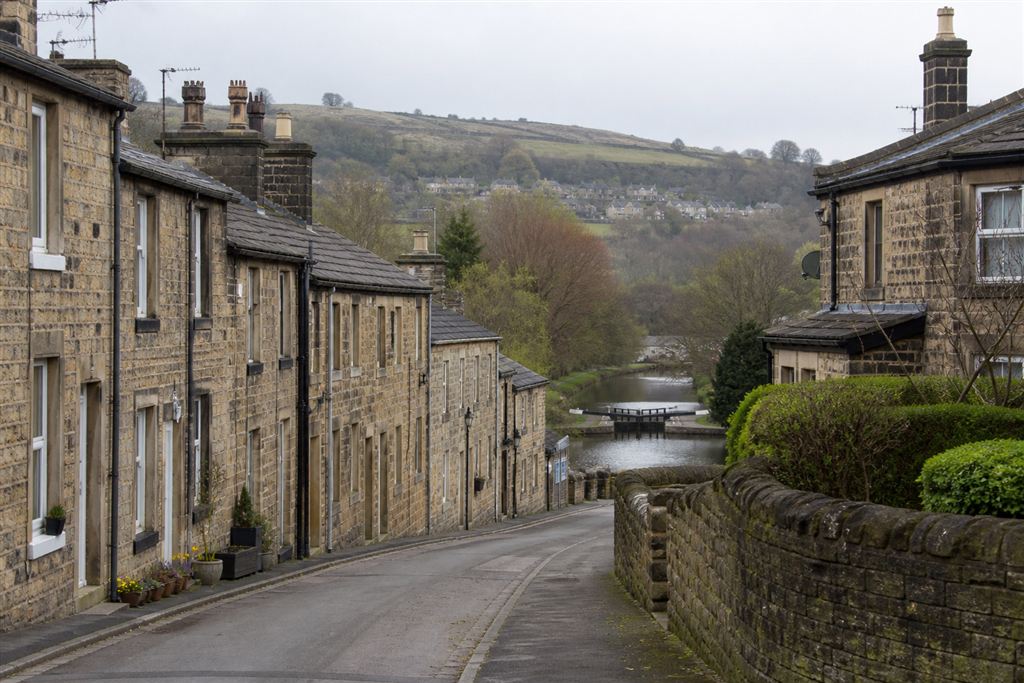
What a wet Bingley cellar usually is — two stocks, one town
Bingley is a mill town that kept building up the hill. The survey has to say which house you have.
Valley floor (mill terrace / town-centre stone). Park Road, Dubb Lane, Wellington Street, Ferncliffe, Cemetery Road, Mornington Road, the streets off Bradford Road and Keighley Road toward the station, and the stone around Main Street and Myrtle Park. These rooms are typically:
- a mill-workers’ cellar or a later store under gritstone or brick, not a one-elevation back-to-back
- sitting on or just above the Aire floodplain, with the canal cut close enough that a leaking pound is a live question
- entered from an internal stair or a side passage — not always through the front room
- wet from more than one possible source (river groundwater, canal seepage, a mill goit, a combined drain)
Uphill suburban. Eldwick, Gilstead, Priestthorpe, Lady Lane, Crownest Lane, the St Ives edge toward Harden. These rooms are typically:
- a later semi or detached cellar, brick, sometimes a small utility rather than a mill hole
- on a slope that sheds toward the valley, not in Flood Zone 3
- wet from hillside groundwater, a failed land drain, or rain through stone — not from Five Rise
Crossflatts is the canal/Aire corridor north of the Five Rise flight. It is an honest nearby street pattern, not a second site and not an areaServed city. If your house is there, say so on the form; the hydrology is Bingley’s, the page is still this one.
Houses on later estates with only a floor slab should say so. We will not invent a Type C job to fill a paragraph.
River, canal, goit — three waters Keighley copy cannot describe
The Aire runs under Ireland Bridge and along Myrtle Park. After a wet week the Environment Agency flood maps put parts of the valley floor in Flood Zone 2 or 3. Cellar water on those streets can be river-related: groundwater in the alluvium, a surcharge in the combined drain when the river is high, or, in a real event, water that has already left the channel.
That is not the whole story, and treating every wet Bingley cellar as “the river” is how a county template fails.
The Leeds & Liverpool Canal climbs Five Rise Locks on the north side of town — five chambers, about eighteen metres of rise. The cut is perched. A pound can weep into ground that sits *below* the canal. A house near the flight, or along the towpath toward Dowley Gap and the Three Rise, can take canal water while the Aire is behaving. Canal seepage does not look like a burst pipe and does not wait for an EA warning.
Older mill sites along Park Road and the Dubb Lane / Wellington Street strip had goits and leats that took water off the river or the cut. Some of those channels are now buried. They still move water. A “dry” week with a wet cellar on the mill strip is often a goit, not a mystery.
Uphill of all of this — Eldwick, Gilstead, Priestthorpe — none of those three sources may apply. There the survey is looking for hillside water and drains, and it says so. Flooded cellar on the Bingley floodplain
This site does not share body copy with Keighley. Keighley’s angle is Worth Valley back-to-backs and access through a front room. Bingley’s angle is a perched canal plus a river plus mixed stock. Swap the town name and this paragraph is false.
Type C, tanking, and slurry — in the language of this house
British Standard BS 8102 describes three ways of keeping groundwater out of a below-ground room. On a Bingley mill terrace or an Eldwick semi we explain them like this:
- Type A (barrier) — a slurry or sheet stuck to the wall, hoping the masonry never moves and the water never sits. On a valley-floor cellar that sees canal or river groundwater this often fails at the floor/wall joint, at a goit-soaked flag, or where millstone and brick meet.
- Type B (structurally integral) — the concrete itself is the tank. That is a new-build idea. It is not how Park Road terraces or 1930s Priestthorpe semis were built.
- Type C (cavity drain) — a dimpled membrane on the inside face, a channel at the floor/wall joint, and a sump that takes water to a drain you already own — if that drain will still take water when the Aire is high. The wall can still get wet; the room stays usable. This is the honest default on this stock.
tanking a cellar on a canal-side terrace cellar tanking vs Type C when the Aire is already in the room Type C cavity drain, plain English
Canal-side and Eldwick specs both mention tanking membrane and cavity drain membrane as parts of a job, never as kits. Bingley Cellar Waterproofing does not run a counter and does not post rolls.
Why a discovery survey comes before any figure
A plumber-template “free estimate” from Main Street cannot see:
- whether the water is river groundwater, canal seepage from the perched cut, a buried mill goit, or a failed land drain on an Eldwick plot
- whether the house sits in an EA flood zone, and what that does to a sump that discharges to a combined drain already surcharged in a river event
- whether access is a mill-terrace stair on Park Road, a passage off Dubb Lane, or a suburban hatch on Lady Lane — and where a pump-out tanker could stand near Five Rise without blocking the locks car park
- whether Bradford Building Control will want a full application, and what flood-history notes they will expect that a Worth Valley job does not generate
- whether a party wall on a mill terrace needs notice before anyone cuts a channel
What the button books is a paid cellar discovery survey with a scope for this plot — Five Rise mill terrace or Eldwick semi. We do not bait with a fake free estimate from Main Street.
Cost is a range with variables, not a doorstep number. Full Type C on a small mill-terrace store and full Type C on a Gilstead utility with a clear rear drain are not the same job. What cellar waterproofing costs in Bingley
Town-centre access is not a Keighley front-room problem
Five Rise, Myrtle Park and Main Street are busy with walkers, lock traffic and station parking. A survey van sits on the property or in a legal bay; it does not occupy the locks overflow as a works compound. Type C is installed from inside. We do not excavate a canal-side elevation as a first move, and we do not trench Myrtle Park.
Quiet suburban access on Eldwick and Gilstead is a different day: drive, rear drain, neighbour-sensitive hours. The page that pretends those two access problems are one “Aire Valley” template is the Keighley clone this site is written not to be.
If a pump-out is needed on a flooded-cellar first visit, we say so on the day — that is a different page. Flooded cellar in Bingley
Not a Bradford list, not a Shipley page, not a mill /near-me/
Quoted search for "cellar waterproofing" Bingley is held by mill /near-me/ URLs and thin damp/conversion templates. Real operators mention Bingley in coverage lists or *project* URLs. Pure’s dedicated Bingley waterproofing slug is a 404; they do own a Shipley money page, which is why this cell stays Bingley and does not swap . This site is not a smear of those firms. It is a neighbourhood specialist page that actually names the canal and the river.
This page is cellar waterproofing in Bingley. We do not list Keighley, Ilkley, Alwoodley, Moortown, or a forty-town dump. We do not add Shipley as areaServed. Immediately adjoining streets that are actually in the town — Crossflatts as canal-corridor fabric, Cottingley as the southern edge — may be named in body as honest geography. They are not extra domains.
We also do not chase basement waterproofing as a money phrase. In this town the room is a cellar. Conversion of that cellar is an upsell after it is dry. Thin conversion mills already spin Bingley ; we do not compete with them on that phrase. Cellar conversion in Bingley (after waterproofing) Every button on that page still books the waterproofing survey.
FAQs
Houses near the Aire / canal: is cellar water river-related or a failed land drain?
It can be either, and it can be both, and it can be the canal instead. On Ireland Bridge, Myrtle Park, Crossflatts and the mill strip, river groundwater and a surcharged combined drain are real. So is seepage from the perched Leeds & Liverpool cut at Five Rise. So is a buried mill goit. A failed land drain is the usual answer *uphill* at Eldwick and Gilstead, and a lazy answer on the floodplain. The discovery survey is there to separate those, not to write “damp” on a clipboard. Flooded cellar in Bingley
Mill terrace vs later suburban Bingley — does the spec change?
Yes. A Park Road mill-terrace cellar is a small room, often shared walls, often a question about where a sump can discharge when the Aire is high. An Eldwick or Priestthorpe semi is a different floor plate, a different drain invert, and usually not a flood-zone problem. Type C is still the honest default on both; the membrane run, the sump location, the party-wall notice and the Building Control note are not copy-paste. If a page offers one spec for “Bingley and Keighley”, it has not looked at either town.
Five Rise / town-centre access and parking for a survey?
The locks, Myrtle Park and the station end of town are the wrong place to assume a works van can sit all day. We survey from the property: internal stair, side passage, whatever the house has. We do not use the Five Rise car park as a compound, and we do not block Main Street. If a later install needs a pump-out tanker, that is booked as a first-response visit with a stated standing place — not improvised next to the flight. Suburban Eldwick surveys are ordinary driveway jobs; do not mix the two in your head.
Bradford Building Control (same district as Keighley/Ilkley) but different flood-history questions?
Bingley, Keighley and Ilkley are all Bradford district for Building Control — not Leeds. That is where the similarity ends. A Bingley valley-floor Type C job should expect questions about flood history, discharge during a river event, and whether the outfall is into a drain that already backs up when the Aire is up. A Worth Valley coal hole and an Ilkley hillside villa do not generate those notes. Structural waterproofing still typically needs an application, not a tin of slurry that skips notice. The survey records the house so the notice is not a template.
If we are uphill of the river, do we still need a sump?
Often yes, if the honest spec is Type C. A cavity drain has to send water *somewhere*. Uphill at Eldwick, Gilstead, Lady Lane and Crownest Lane that “somewhere” is usually the existing rear combined drain, and the pump is small and occasional. You need it because the membrane system drains, not because Five Rise is about to overtop your garden. You might *not* need a flood-event battery pack that a Myrtle Park cellar would be foolish to skip. That distinction is the survey, not a website rule.
Why this is not the Keighley page with the town name changed?
Keighley copy is mill terraces, back-to-backs, Worth Valley stone, access through a front room, Aire–Worth confluence. Bingley copy is a perched canal at Five Rise, the Aire at Ireland Bridge, mill goits on Park Road / Dubb Lane, town-centre stone at Myrtle Park, and later suburban stock at Eldwick and Gilstead that Keighley mill streets do not have. The spec, the flood questions, the sump discharge and the photos are different. If a sentence on this site still reads true with “Keighley” swapped in, it should be rewritten — that is the doorway test, and this page is written to fail it.
Crossflatts is on the form — is that a different website?
No. Crossflatts sits on the same canal/Aire corridor as Five Rise. It is named because the hydrology is this town’s, not because we are building a sixth domain. Same for Eldwick as the uphill suburban edge. Cottingley may appear as the southern edge in a sentence. None of them are extra sites. Shipley is not served on this domain.
Do we still need Type C if a previous “tanking” coat is already on the wall?
A grey slurry or old bitumen on a mill-terrace wall is usually failed Type A, not a reason to overlay and trap canal or goit water. We strip the wet zone after survey and specify a drained cavity if the room is used. Overlaying millstone or wet brick because a search phrase said “cellar tanking” is how those coats fail the second time. Cellar tanking in Bingley